Ready to start your Houston EMT training? Register online here to begin! Make sure to download and complete the EMT Program Information Packet, which outlines all requirements you will need to fulfill before classes begin and your clinical externship starts.
EMT students must prove proficiency in managing emergencies utilizing all Basic Life Support equipment and skills in accordance with all behavioral objectives in the DOT/EMT curriculum. The course shall include a minimum of 150 hours of training of classroom, laboratory, clinical and field instruction which shall include supervised experiences in the emergency department and with a licensed EMS provider and other settings as judged appropriate by the Program Director.
Our curriculum aligns with nationally recognized EMS Education Standards for the Emergency Medical Technician, the National EMS Education Standards as well as meet Texas Department of State Health Services educational standards.
Emergency Medical Technician (EMT) Course Textbook
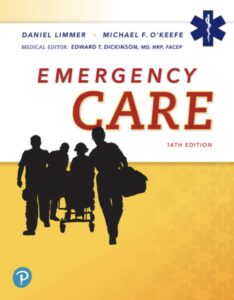
Course Textbook: Emergency Care (14th Edition) / Pearson Education
Subjects Covered in the EMT Course
| Course Introduction and Overview | Emergency Medical Care Systems, Research and Public Health | Workforce Safety and Wellness of the EMT | Medical, Legal, and Ethical Issues |
| Documentation | Communication | Lifting and Moving Patients | Lab: Lifting and Moving Patients |
| Anatomy, Physiology, and Medical Terminology | Pathophysiology | Life Span Development | Airway Management, Artificial Ventilation, and Oxygenation |
| Baseline Vital Signs, Monitoring Devices, and History Taking | Scene Size-Up | Patient Assessment | Pharmacology and Medication Administration |
| Shock and Resuscitation | Respiratory Emergencies | Cardiovascular Emergencies | Altered Mental Status, Stroke, and Headache |
| Seizures and Syncope | Acute Diabetic Emergencies | Anaphylactic Reactions | Toxicologic Emergencies |
| Abdominal, Gynecologic, Genitourinary and Renal Emergencies | Environmental Emergencies | Submersion Incidents: Drowning and Diving Emergencies | Behavioral Emergencies |
| Trauma Overview: The Trauma Patient and the Trauma System | Bleeding and Soft Tissue Trauma | Burns | Musculoskeletal Trauma |
| Head Trauma | Spinal Column and Spinal Cord Trauma | Eye, Face, and Neck Trauma | Chest Trauma |
| Abdominal and Genitourinary Trauma | Multisystem Trauma and Trauma in Special Patient Populations | Obstetrics and Care of the Newborn | Pediatrics |
| Geriatrics | Patients with Special Challenges | Ambulance Operations and Air Medical Response | Gaining Access and Patient Extrication |
| Hazardous Materials | Multiple Casualty Incidents and Incident Management | Response to Terrorism Involving Weapons of Mass Destruction |
